Blog

Documentation, documentation, documentation

Writing reports accounts for quite a lot of my working time. There are condition reports, treatment recommendations, loan reports, treatment reports. I’m never far from my notebook when I’m working.


These reports aren’t just box-ticking (although sometimes box-ticking is exactly what’s involved) but are important records of the works at a particular time. Sometimes it’s obvious what purpose a report will serve. When a work goes out on loan for an exhibition, whether that’s between galleries or to a gallery from a private collection, we need to make a note of its condition before it travels and see how it looks when it gets there.

Other reports I write are often for the interest or information of some unknown person at an unspecified time in the future. Sometimes it can feel a bit futile, as if nobody will be interested, but actually I’m always grateful to see a previous report for a painting I’m looking at. It’s reassuring when you find that nothing much has changed, or it can narrow down a time period during which a change has occurred; it can save you time if the previous conservator has recorded something that will influence your treatment proposal.

Something I hadn’t previously considered is that there is the possibility that something I record could be more significant than I understand at the time. Recently in the news there was a story of a painting being identified as Nazi loot thanks to the detailed condition report of a museum employee during the occupation of France who recorded the presence of a small hole in the canvas. This, along with the present day conservators who have looked carefully and recorded what they’ve found and compared it to these old reports, should lead to the painting being reunited with the family that it was stolen from. Whilst I expect that most of the reports I write will be merely of interest in the future, the potential for my observations to be of greater significance will keep me motivated as I sit down to write the next batch.
Framing

Conservation framing

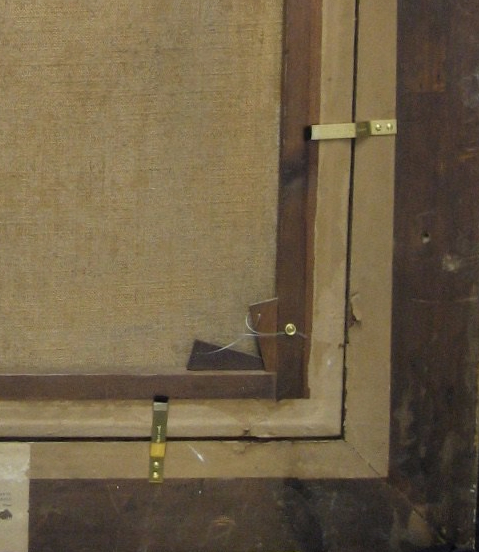
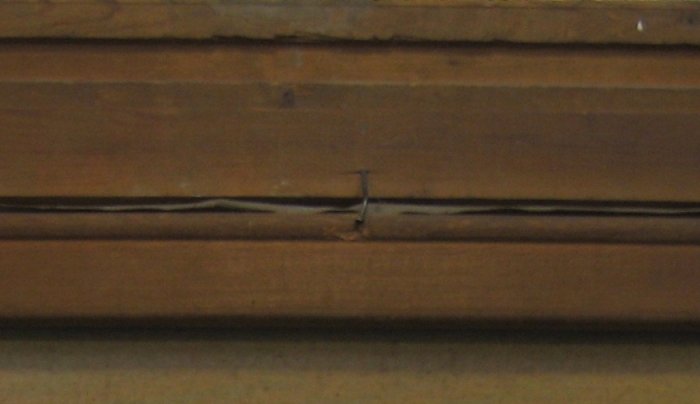
When a picture comes in to me for conservation treatment one of the first things I have to do is get it out of its frame if it has one. This may sound straightforward but it can be one of the most frustrating and potentially dangerous jobs, depending on the approach the previous framer has taken. Occasionally in older paintings still in their original frames the framer has made wooden buttons that are screwed to the frame and can be turned the let the painting out (I love these) but unfortunately panel pins are far and away the most common method of securing an oil painting in its frame. Sometimes they have been knocked into the frame and bent around the back of the painting (forgivable), sometimes knocked right through the stretcher and into the rebate (awful). Sometimes the frame isn’t even a complete object in its own right and is simply pinned to the outside edges of the stretcher (nightmare). Once I’ve finally managed to remove whatever rusty nails have been holding the picture in I sometimes find that the picture still won’t come out. Maybe it’s been put into the frame too soon after varnishing, maybe there’s another sneaky pin somewhere…

IMG_0958

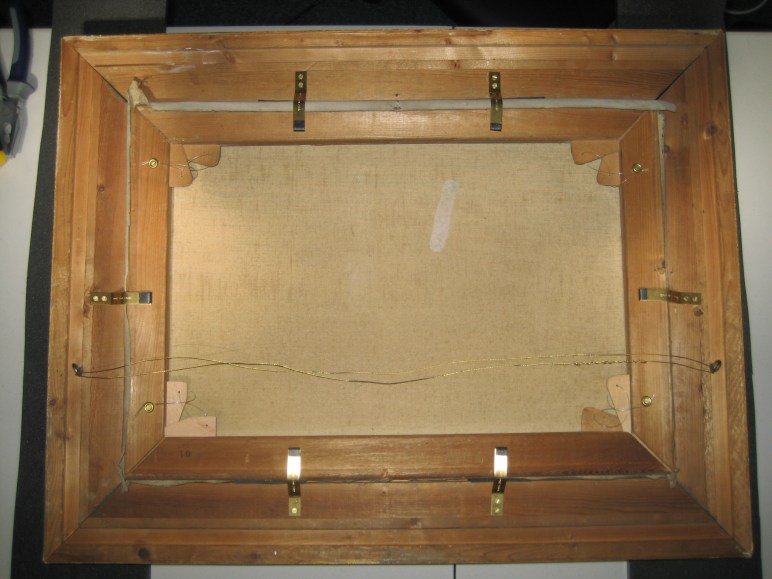
Whatever torment the previous framer has devised I can usually do my best to ensurethat the next person to take the picture out isn’t cursing me. One of the first things to do is clean the rebate and line it with cushioned tape to make a softer interface between the frame and the front of the painting. Then come the fixings. There are a number of ways to hold a picture in a frame but my favoured method uses brass strips. These little strips can be bent quite easily to fit the profile of the painting in the rebate and they have a little bit of flexibility to accommodate movement due to environmental fluctuations. They are then secured with brass screws, which can be removed without anyone having to break a sweat.

fullsizeoutput_42c8

Drying cracks

IMG_3535
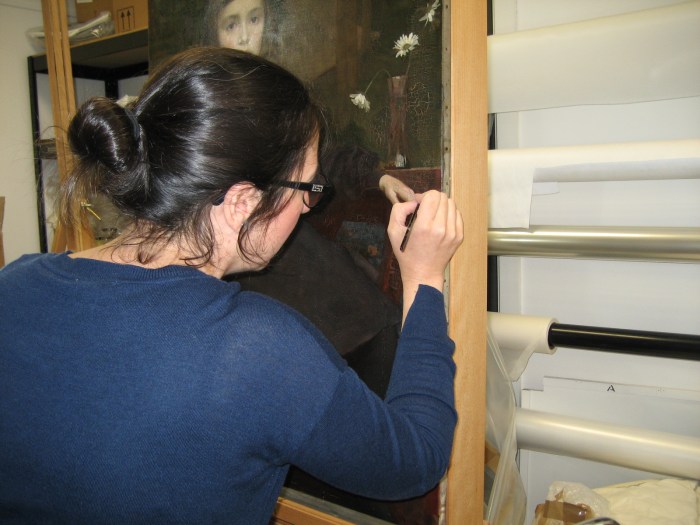
Beth retouching drying cracks with a small sable brush

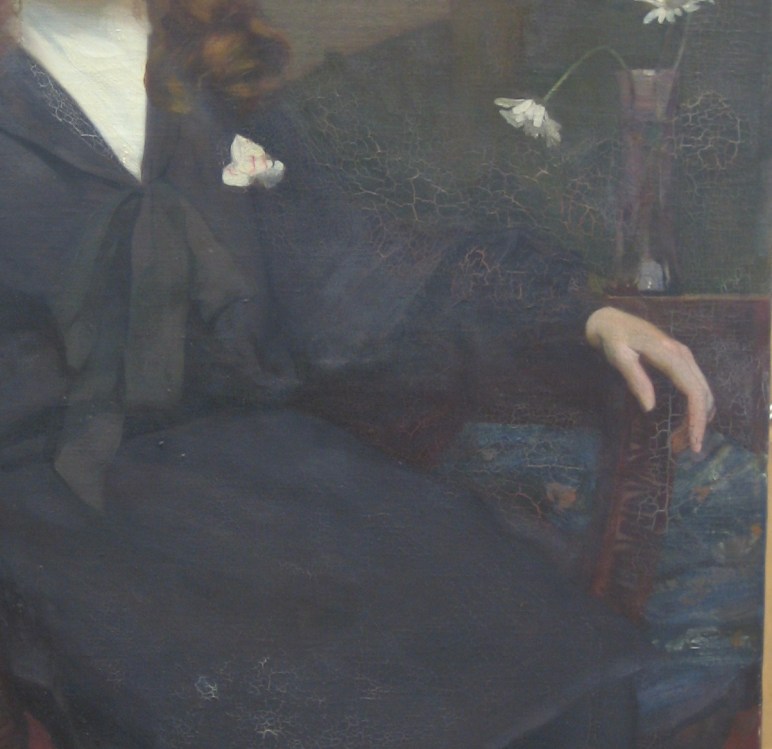
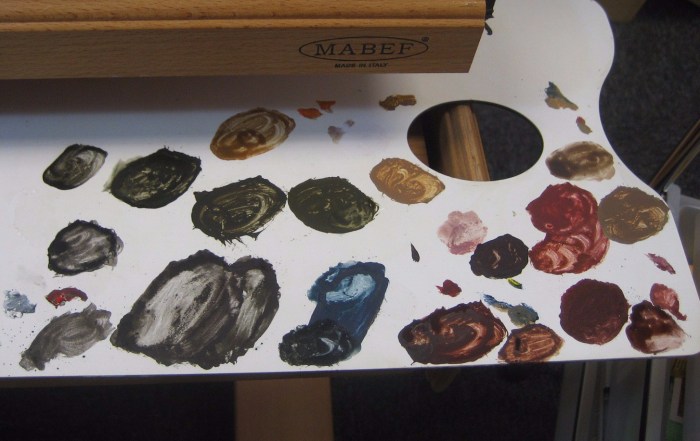
I’m currently working on a lovely portrait from the early 20th century that has extensive drying cracks. Although drying cracks can be quite alarming to look at they are usually completely stable. They occur when the upper paint layer dries more quickly than the one below, which means that as the wet layer underneath shifts as it dries the upper layer is pulled apart. Sometimes drying cracks aren’t particularly problematic but in this case a lot of white is showing in a black field of colour. When a paint layer is damaged your eye is drawn to the damage rather than seeing the subject, so I’ve been retouching the widest of the drying cracks to give some solidity to the forms. The medium I’m using for retouching has completely different solubility parameters to the original paint, which will make it reversible in the future if necessary.

IMG_3529
My retouching palette for this painting